Pages

Showing posts with label Sharkwater. Show all posts

Wednesday, December 21, 2011

Nominate Kathy Pagapular Ruszala's Sixth Grade Class for a Peter Benchly Ocean Award

Here it goes, I'm asking for your help yet one more time. Will you nominate Kathy Pagapular's San Vicente Elementary School Sixth Grade Class for a Peter Benchley Ocean Award in Youth Activism? Kathy's class supported shark protections in the Northern Marianas this year and jumpstarted momentum for a year of shark conservation. They deserve recognition.

Click here to learn how to nominate San Vicente Elementary School for a Peter Benchley Ocean Award in Youth Activism.

The deadline for nominations is December 31, 2011. Nominations should include 2- 6 paragraphs on the nominee and why the nominator finds them deserving in their category. Feel free to include supporting materials and/or links. Please include the nominees contact information and your contact information.

Submit to benchleys@bluefront.org. Mark subject line - Benchley Nomination - Youth Activism. Nominators names will be held in confidence.

2011 was a watershed year in shark conservation. And where did it all start? Saipan. On January 27, Governor Ben Fitial signed a law criminalizing the sale, trade, and possession of shark fin. This act kicked off 12 months of improved protections for sharks, including shark sanctuaries in The Bahamas, Honduras, the Marshalls, and Tokelau, shark fin bans in Guam, California, Washington, Oregon, and half a dozen Canadian cities, protections for oceanic whitetips, hammerheads, and silky sharks on the high seas, and agreements by international and regional bodies to implement more protections in 2012.

The law in the Northern Marianas was supported by many in the community, including fishermen, divers, and the conservation-minded, but a sixth grade class at San Vicente Elementary School may have done more than anyone else to make sure sharks received protections.

I could tell their story, but filmmaker Rob Stewart does it much better with his short film Sharkwater Saipan. This short film is just a preview of Rob's second feature film Revolution, due out in theaters next year.


Watch Sharkwater Saipan on Youtube.

I am asking you to write your own nominations (but I am available to help or edit). Two paragraphs should not be that difficult. Think of this award as something that will come home to the Marianas, not just San Vicente Elementary.

I make this request as the Saipan Blogger and the Godfather of the Mariana Trench Marine National Monument, not as someone who works for an organization that shall go unnamed. I have had the honor of meeting many shark champions around the world this year including Tony DeBrum from the Marshall Islands, Ev Quiel and Melanie Blas on Guam, Manoa Rasagitale in Fiji, Rob Stewart in Canada, and many others, but my home and my heart lies with Saipan. So let's bring that award home!

Friday, June 10, 2011

Sharkwater Saipan


Check out what Kathy Pagapular's 6th grade class at San Vicente Elementary School were able to accomplish with the help of Sharkwater's Rob Stewart and some other very dedicated adults. I hope this inspiring video goes viral, and I'd appreciate anything you can do to put it in the blogosphere, Twittersphere, or Facebooksphere.

Sunday, January 30, 2011

New Shark Fin Ban in Northern Mariana Islands

New Shark Fin Ban: (from left to right) Filmmaker Rob Stewart, Laurie Peterka, Shawn Heinrichs, Cinta Kaipat, Meaghan Hassel-Shearer, and Northern Mariana Islands governor Benigno R. Fitial during the shark fin signing.
Shark finning ban now a Northern Mariana Islands law

The Commonwealth of the Northern Mariana Islands (CNMI) marked another milestone yesterday by becoming the first U.S. territory to ban shark fins.

It was inspired by Hawaii, the first U.S. state to make it illegal to possess, sell or distribute shark fins. The CNMI, in turn, inspired Guam to also introduce a similar bill.

Gov. Benigno R. Fitial, who signed the bill into law yesterday morning, said this should also inspire other island nations and countries to pass their own shark protection laws.

A Proud Moment: Local officials and filmmaker Rob Stewart join (front row: left to right) Governor Benigno R. Fitial, Lt. Governor Eloy Inos, and Delegate Gregorio Camacho Sablan for a ceremonial signing on Saipan.
The new law prohibits possession, selling, offering for sale, trading, or distributing shark fins in the CNMI. It, however, allows catching of sharks for subsistence or non-commercial purposes.

Shortly after Fitial signed the shark protection law, the Humane Society International, Shark Savers, and WildAid congratulated the CNMI leadership “in championing shark protection in the region.”

“With passage of this bill, yet another region of the Pacific takes a strong stand against the trade of shark fins and the sale of shark fin soup. It sets a great example for the region to ensure a sustainable future for the islands,” said WildAid executive director Peter Knights.

Fitial said he received only positive comments about what he described as a “landmark” legislation, and that he was never pressured by anybody not to sign the bill.

“Today, we proudly follow suit behind Palau's creation of a shark sanctuary in 2009, Hawaii's law banning all shark products in 2010, and President Obama's enactment of the Shark Conservation Act just this past January 4th,” Fitial told the crowd inside the conference room who witnessed the signing.

Restaurants in the CNMI that possess shark fins may still serve shark fin soup, sell or offer for sale shark fins within 90 days from yesterday. After that, it will be illegal to do so.

Work doesn't stop here

House minority leader Diego T. Benavente, the bill's author, said the work does not stop here. He said attention should be focused on enforcing the law.

“I'm just so happy that it's signed into law not because it's my bill and that it's the first public law to be signed this year. It's because of the fact that I truly believe in the legislation, that it will make a difference in the lives of CNMI people but also to people in other parts of the world by helping to protect sharks and the marine environment,” said Benavente, a fisherman himself.

Persons found in violation of the new law may be fined not less than $5,000 but not more than $30,000, and/or imprisoned for not more than six months.

This early, Fitial said, he has already received inquiries from a Hong Kong-based entity planning to come to the CNMI for eco-tourism, as a result of the anti-shark fin law.

Sharkwater: Rob Stewart
at the shark fin ban signing

Rob Stewart, director of the acclaimed documentary Sharkwater, was also at the bill signing, which he said will be included in his next film.

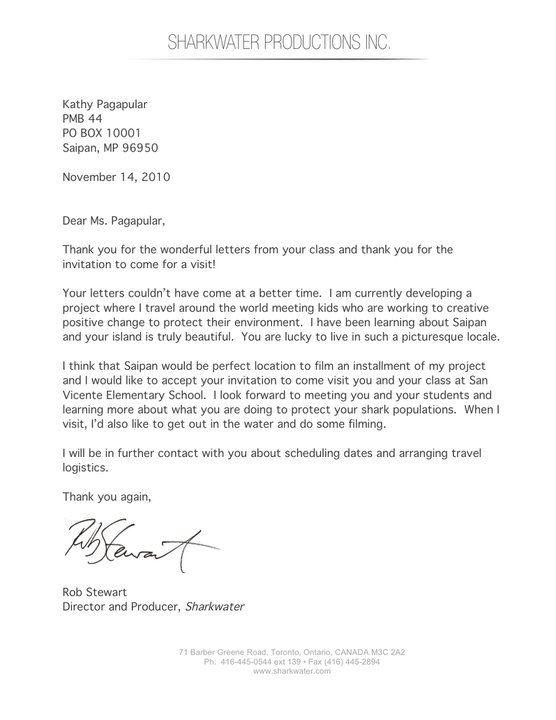
Stewart came to Saipan at the invitation of San Vicente Elementary School's sixth grade students of teacher Kathy Pagapular.

“I could have said no, but the fact that a grade 6 class sees that there's a change needed in the world and tries to do something about it, it's huge, and if I could play any part in encouraging young people to take matters into their own hands and try to make the world a better place, I'll do that,” he said in an interview.

After spending Wednesday diving with sharks and hanging out with eagle rays, Stewart said it's an amazing experience to witness the Thursday bill signing, which he hopes will be replicated in other island nations and countries.

Also present at the bill signing were Lt. Gov. Eloy S. Inos, Delegate Gregorio Kilili Sablan, Speaker Eli Cabrera (R-Saipan), Senate President Paul Manglona (Ind-Rota), Tinian Mayor Ramon Dela Cruz, other CNMI lawmakers, other government officials and community members supporting a global movement to protect sharks.

Last-minute calls

On the eve of his bill signing, Fitial said he got a call from Pacific Regional Fishery Management Council executive director Kitty Simonds at 9:30pm on Wednesday, but he said the call was only to remind him that there's already a federal law that prohibits shark finning.

Wespac is tasked with managing fisheries in U.S. waters in this part of the world.

Fitial, in an interview with reporters after the bill signing, said he told Simonds he's aware of the federal statute which he thinks is stricter than the one he's about to sign. The governor said he's comfortable with the bill he signed.

The governor said he also got a call from Hawaii State Sen. Clayton Hee early Thursday morning, asking whether he would sign the law after reports came out that there were some concerns about it.

“I told him the specific time that I'd sign the law-at 9:30am,” Fitial said, adding that Hee would have wanted to come to Saipan for the signing.

Hee's bill became the strongest shark protection law in the nation. He was on Saipan in December to drum up support for Benavente's bill, which is modeled after Hee' bill that became law in Hawaii last year.

Fitial said the CNMI has seen much progress in preventing overfishing, minimizing bycatch, and protecting fish stocks and habitats. “However, there is still room to do more,” he added.

To protect its natural wealth, the CNMI has created marine protected areas, has been doing coral reef monitoring, and holding educational outreach programs to teach people about the importance of conservation, among other things.

“Now with the implementation of the Shark Fin Prohibition Act, we can add protecting the animals at the top of the marine food chain-sharks-to that list,” said Fitial.

Fitial, who was also interviewed by Stewart for his Sharkwater sequel, shared that sharks also have medicinal uses. He said when he was still infant, his folks used shark liver to help cure him of an illness.

Positive international spotlight

Up to 73 million sharks are used in shark fin soup every year and the trade has been the major factor in the decimation of global shark populations.

Humane Society International said they have already seen the positive ripple effect as Guam's legislature has picked up the torch from the CNMI and is contemplating a similar bill.

“The legislation shines a positive international spotlight on the CNMI and positions the islands as a pioneer in shark and ocean conservation,” said Iris Ho, wildlife campaign manager for Humane Society International which, together with its partner organizations, is one of the world's largest animal protection organizations.

Shark Savers, an international shark conservation organization, said the historic CNMI law recognizes that “sharks are one of the top predators in the marine food chain and play an important role in our ocean's ecosystem. Sharks have characteristics that make them more vulnerable to overfishing than most fish.”

It said the CNMI joins island nations and regions in taking strong actions to protect sharks, including Palau, the Maldives, and Raja Ampat, Indonesia.

“One by one, Pacific Island communities like the CNMI are taking steps to protect valuable shark species to ensure the health of their precious marine environments,” said Michael Skoletsky, executive director of Shark Savers.

Benavente's bill, House Bill 17-94, House Draft 1, Senate Draft 1 is now CNMI Public Law 17-27.

Published in the Saipan Tribune on Friday, January 28, 2011

Wednesday, January 26, 2011

Shark Tourism Possible Revenue-Generating Resource for NMI

Re-printed from the Marianas Variety

‘Shark tourism’ a possible revenue-generating resource for NMI
Wednesday, January 26, 2011 12:00AM By Raquel C. Bagnol - Reporter
E-mail Print

WITH over 30 species in CNMI waters, “shark tourism” can be a possible resource to generate more revenues in the commonwealth.

“Sharkwater” director Rob Stewart asks the community to support the anti-shark fin law during the Saipan Rotary Club meeting at the Hyatt yesterday. Photo by Raquel C. Bagnol “Sharkwater” director Rob Stewart, who was yesterday’s speaker at the Saipan Rotary Club meeting at the Hyatt, said shark tourism is a form of ecotourism in which the communities help tourists and divers see live sharks.

Stewart said shark tourism is becoming a success in some places such as Australia, South Africa, New Zealand, Bahamas and Palau.

“Each year, hundreds of divers and tourists come to these places to see live sharks underwater, and this is one way the CNMI can benefit from its underwater resources,” he said.

He also discussed the importance of the shark fin ban measure, which the governor is scheduled to sign on Thursday.

He said the CNMI will become one of the few jurisdictions in the world to ban shark finning.

“Shark finning is an unmonitored and unmanaged multi-billion dollar industry, and each year, over 100 million sharks are killed for their fins,” Stewart said.

A pound of dried shark fin can retail for $300 to $400, and shark finning has increased for the past decades due to the increased demand for shark fin soup and traditional cures, he added.

Stewart said it took him over five years to film “Sharkwater,” a documentary which won 22 international awards, and his aim is to get people to think of sharks differently.

“Sharks are not dangerous. They’re not mindless killers and they are not interested in people. Sharks are the ones who are in danger around people,” he said.

He said people should start to realize that “if we are going to survive on this planet as a species, we need to conserve it and protect the sharks.”

Steward said shark finning, which is the removal of shark fins and discarding the shark carcass back to the sea, is equivalent to cutting off a man’s arms and legs and throwing him into the forest.

“Sharks sometimes take a day or two to die and when they are tossed back into the sea without fins, they will be unable to swim. They sink slowly toward the bottom of the sea and wait to die and be eaten by other fish,” Stewart said.

He said any shark regardless of age and size of species can become the victim of shark finning anywhere in the world.

Monday, January 24, 2011

Rob Stewart Cleans Up Saipan

Photo: Aya Matsumoto
'Sharkwater' director, volunteers conduct Sunday beach cleanup
Saipan Tribune

Rob Stewart, the acclaimed director of the documentary Sharkwater, joined some 30 volunteers during the beach cleanup behind Aquarius Beach Towers in Chalan Kanoa yesterday morning.

The volunteers collected a truckload or about 120 lbs of trash from the beach down by the Sugar Dock and all the way to the Aquarius beach.

Beautify CNMI!: Cinta Kaipat, Rob Stewart, Shawn Heinrichs, and Aya Matsumoto
Having participated in a recent beach cleanup in Hong Kong, Stewart noted the importance of doing beach cleanups regularly.

“It shows a great sense of care and investment in your land,” Stewart told Saipan Tribune.

Friday, January 21, 2011

Rob Stewart of Sharkwater to speak at AMP on Monday!

Rob Stewart (the director of "Sharkwater", will be visiting the CNMI this upcoming week and will speak at American Memorial Park at 6:30pm this Monday (Jan 24th).

Rob will be showing some of the footage he has accumulated on sharks on his world-wide travels filming them, as well as discussing shark conservation efforts, how the CNMI community can get more involved, and the work on his upcoming film (part of which he is filming here in the CNMI!)

Please join us for this exciting and rare event at AMP this Monday, and please help us spread the word to others that may be interested.

The event is free and open to the public; seating is limited, so come early to ensure admittance. For planning purposes, the event is expected to last between 60 and 90 minutes.

Wednesday, January 12, 2011

Celebrity Beach Clean Up!

This just in from MINA (Mariana Islands Nature Alliance):


Greetings! Next week, Saipan will be host to an amazing individual. Rob Stewart, the acclaimed filmmaker and director of the documentary, "Sharkwater" will be participating in a MINA sponsored beach clean up for youth volunteers on January 23rd from 9am - 12pm, at the beaches behind Aquarius Hotel.

MINA will be providing trash bags and gloves to aid in garbage collection, as well as coolers and ice. Volunteers are asked to help with a case of water per group so that everyone could stay hydrated throughout the days events. Everyone is welcome to come!

For any information please call Sam Sablan or Jon Igitol at 233-REEF.

Visit MINA on the web at http://www.minapacific.org/

Wednesday, November 17, 2010

The Power of Sharing and Joining Efforts

As a supporter of FirstFridayFilms, we have some really cool news to share with Beautifiers! An active SVES teacher, Kathy Lalaine Pagapular got a letter this week from Rob Stewart, the director and producer of the film Sharkwater. And guess what? He's coming here!!!


You might ask, "How did this happen?"

Well, Kathy attended FirstFridayFilms showing of the film Sharkwater. She thought it was so cool and that it was something that she could share in her classroom, so she asked if she could have permission to show the film to her students. The students got so excited and so interested that they decided to write to Rob Stewart and invite him to visit the CNMI.

Amazing stuff, eh? This is the power of sharing and joining efforts. This is the spirit of Beautify CNMI!

Kudos Kathy! Kudos FirstFridayFilms!

Go San Vicente Elementary School!

Sunday, August 01, 2010

First Friday Films to Present Sharkwater on August 6

Hello Beautify CNMI! Volunteers:

Don't miss the next First Friday Films this Friday, August 6. See invitation below from Aric Bickel of DEQ. ENJOY!

Media Partners, please promote this event. Thank you!

****

Subject: First Friday Films presents SharkWater on Aug. 6th

Hello All,

We are just over a week away from our August First Friday Films event where we will be screening the award winning film "SharkWater". The event will naturally be on the first Friday of the month (August 6th), at 7:00pm at the American Memorial Park Visitors center.

The winner of 31 international awards, Sharkwater is a film documenting the exploitation and corruption surrounding the world’s shark populations and the effect we are having on our ocean ecosystems by removing these important predators. Director Rob Stewart explores the culture of fear that has contributed to the mismanagement of these creatures as well as the multi-billion dollar industry that has led many shark species to the brink of extinction. Stewart's journey to explore the last safe havens left for sharks inadvertently pits him against black-market industry leaders and leads him on an adventure that threatens not only the life of many of these species but also his own.

Please join us for this wonderful documentary as well as a discussion about CNMI shark populations led by officials from the Division of Fish and Wildlife (DFW) directly following the film. For more information about the film and to see the official trailer please visit http://www.sharkwater.com/.

For updates on First Friday Film events and more details including film review and trailers for our films please visit our website: http://firstfridayfilmssaipan.blogspot.com/.

We hope to see you next Friday!

Cheers,

Aric Bickel


www.beautifycnmi.org


---Cinta M. Kaipat
Volunteer PR Coordinator
www.beautifycnmi.org