
The CNMI is not lacking in old historical sites, but we are lacking in funds to take care of them. The Old Japanese Jail is no exception. It is along Middle Road in Garapan, right in the middle of a residential neighborhood. An Auto Repair shop sits right next to it, too.
Beautify CNMI! partnered with Northern Marianas College and volunteers from Mariana Islands Nature Alliance, Friends of the Mariana Islands, ISK8, Rep. Cinta Kaipat's Office, Rep. Absalon Waki's Office, ISA CNMI, and Troops to Teachers to clean up this historical tourist spot on Earth Day 2007.
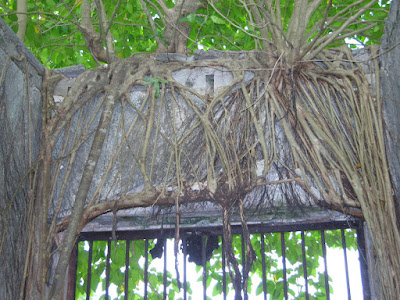
We were very careful not to harm the decades old structure. Vegetation is growing into the sides of several of the structures and large portions of the building are literally crumbling after surviving World War II and decades of earthquakes and typhoons.

We didn't touch the structure. All we did was cut the grass, remove litter, and pull some weeds.
The largest structure at the Old Japanese Jail historic site is the Main Jail. There is a single row of different sized jail cells, each meant to house between 1-6 prisoners. All that remains of the structure are concrete and rusted metal.

Each cell had a wooden floor about two feet off the ground (you can see where it was in the following picture) and a Japanese style toilet in the corner.
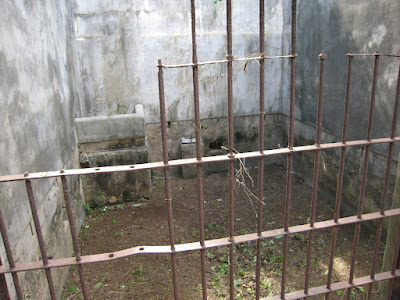
The jail held Japanese, Okinawan, and Chamorro prisoners. Most of the Chamorro prisoners were held for drinking alcohol, which was forbidden by the Japanese Administration.
The main jail has a lot of "historical graffiti:"

Someone named J.A. Beiser left his mark on the Japanese Jail. June 15, 1944 is the day that the Allies landed on Saipan. No one has ever found J.A. Beiser, so we can only guess as to why he carved his name. Was he being held in the jail and released when the Allies landed? Did he carve this on June 15? Did he die during the landing? Did someone else carve this? We'll probably never know.

Some of the prisoners also left their mark. This is carved into the cell where Amelia Earhart is purported to have been held. Can you read Japanese? Care to translate?
Outside of the main jail are the remains of two small structures.

This is the old water well. When we found it, it was full of garbage. We cleaned it out, but didn't find any water.
The other structure is what I have affectionately coined the "Tea House."
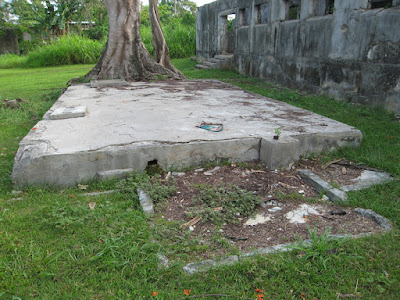
A more appropriate name for the Tea House might be the "Torture Chamber" or simply, "The Hole." The small square in front of the larger concrete structure is believed to have been a staircase leading down to a door for this underground structure. That little rectangular hole on the center left provided all the light for the unfortunate prisoners inside.
Chamorros who survived the war have described to historians how this underground structure was used to house the really bad prisoners. Once you were thrown into the Tea House, you usually weren't brought back out until you were dead.
This structure is believed to have been the women's quarters:

The vegetation growing in and on top of the structure can not be removed without harming it.
This structure is believed to have been the mess hall:

Sam McPhertes told us a story about how the mess hall sink doubled as an interrogation room. The prison guards filled the sink with water and asked the prisoner if they were guilty. If they said "yes," they were thrown in jail, but if they said "no," their head was forcefully dunked into the sink. After a few seconds with their head in the water, they were asked again if they were guilty. This was repeated until the prisoner confessed.
The other remaining structure at the Old Japanese Jail historical site is a large concrete wall. Like many of our historical sites, the wall is covered in clues as to how violent the Battle of Saipan was.

It is not know what this wall was used for. Could it have been for executions? Those bullets could be from the war, or from the guards taking target practice, or from a farmer shooting his chickens. Who knows?
But the bullet holes are nothing compared to these holes:

A mortar shell must have hit the wall here (I don't think a farmer shooting his chickens did this). This is steel reinforced concrete. Look how the impact just bent the rebars!
If anybody would be interested in heading a Restoration sub-committee to restore historical sites in Saipan and throughout the CNMI, please contact me and we'll put something together.
Thanks to everyone who volunteered to restore this important historical site!


