Local
Sunday, February 17, 2008
Beautify CNMI looking for award nominations
The Committee Chairs of Beautify CNMI are seeking nominations for their annual Beautify CNMI Steward and Beautify CNMI Champion awards. The two awards will be given out at the annual Beautify CNMI anniversary dinner to take place on March 27.
The awards are given out to recognize the individuals or groups who have been environmental leaders during the past 12 months.
There are two award categories, the Environmental Steward and the Environmental Champion.
The Environmental Steward award recognizes a person or group that leads the community in activities that help protect our environment in a variety of ways. This individual or group has demonstrated the need to take pride in our islands and to take care of the place we all call home. They serve as an example for others, especially the next generation, to follow.
The Environmental Champion award recognizes a person or group that exemplifies the Beautify CNMI spirit. Those qualities include volunteerism, cooperation, innovation, creativity and the ability to infect others with the Beauty Virus. The Environmental Champion is a role model for others to follow. They bring environmental issues to the forefront of public consciousness. They make things happen and effect change.
Last year's Environmental Champion winners were PSS teacher Bree Reynolds, MINA board member Kathy Yuknavage, and local activist Captain Carl Brachear. The winners of the Environmental Steward award were elementary school student Adam Sablan and volunteer group Friends of the Mariana Islands.
To nominate an individual or group, submit a written nomination explaining why that person or group deserves recognition. You can make as many nominations as you like, but individuals and groups can only be nominated for one award category. Nominations must include the award category the nominee is being considered for, a well written argument detailing the reasons why this nominee should be considered, and contact information for the nominee and for the person making the nomination.
Send nominations to Angelo Villagomez at angelovillagomez@gmail.com or mail them to PO BOX 505149; Saipan, MP 96950 or call the PTI sponsored Beautify CNMI volunteer line at 285-6462 for more information. (PR)
Showing posts with label Beautiful Places. Show all posts
Showing posts with label Beautiful Places. Show all posts
Sunday, February 17, 2008


Tuesday, August 07, 2007
East Obyan Latte Site
 So who told the NMC students about the East Obyan Latte Site? I've walked by it a dozen times and I had no idea it was there.
 Even if I had stumbled upon it, I probably would have thought that they were just a bunch of rocks. I imagine that this is one reason why there are so few latte stone houses left in the Marianas. Even if the Japanese or Americans had cared enough about the cultural symbol of the Marianas to protect them, were they even educated enough to recognize them? I doubt it.
 Luckily we have the people at Historic Preservation Office to help us recognize historical sites. They are there should we have any questions. They might not know all the answers, but they are at least there to give us some insight.
 I hate to have to admit this, but even after we finished clearing the historical site, it still kind of looked like a bunch of rocks in a clearing. (hangs head in shame).
 HPO has a grant to design and build information signs for some of the historical spots around the island. Within the year, tourists and locals who visit this and a few other selected sites will be able to learn about some of the history of these islands.
 History is piled on top of history in Saipan. This cement post was put here by NKK before World War II. It is right in the middle of the latte stone site.
 So there it is. Go check out the site. To get there, park at the end of the paved parking lot at Obyan Beach, walk through the concrete structure, and right before you get to the beach, look left. You'll see a clearing with the latte stones in the middle.
Monday, April 30, 2007
Taga Beach, Tinian
Taga Beach is on the South end of Tinian, within walking distance of the village of San Jose village and the Tinian Dynasty Casino. Right next to the beach are picnic facilities, parking, and even a place to rent a scooter.
It is a small pocket beach with small limestone cliffs on either side. To get down to the beach one has to climb down some rocks, but most prefer to just jump into the clear green and blue water from the small cliffs.
 This is the most popular way to enjoy Taga Beach.
1. Walk down the concrete path in the above photo to get to the edge of the cliff.
2. Jump in
3. Swim to shore
4. Climb up the rocks to get back to the top
5. Repeat.
Here are steps 1-3 in full color, set to music, of course:
The different hues of green and blue are simply amazing:
 You have to climb up the rocks in the following picture to get off of the beach. If you don't think you can climb these rocks, don't jump in the water.
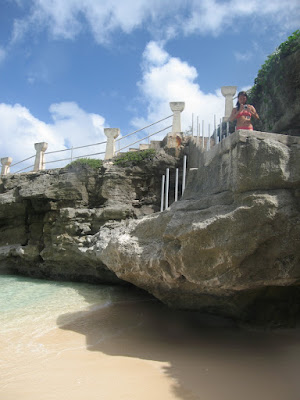 I'm not sure how I feel about the latte stone railing. While I can appreciate the need to keep people safe, think how beautiful these rocks would be without the metal and concrete.
 The kids on Tinian have turned jumping off these rocks into an art form. They pressure each other to jump a little higher, or to throw in a flip, or to get more of a running start.

 They obviously don't challenge each other to be more graceful divers. The kid in the previous two pictures performed belly flop after belly flop after belly flop.
 If jumping off the cliffs ever gets tiring, you can check out the limestone along the beach. The waves have carved some pretty crazy shapes.
It is a small pocket beach with small limestone cliffs on either side. To get down to the beach one has to climb down some rocks, but most prefer to just jump into the clear green and blue water from the small cliffs.
 This is the most popular way to enjoy Taga Beach.
1. Walk down the concrete path in the above photo to get to the edge of the cliff.
2. Jump in
3. Swim to shore
4. Climb up the rocks to get back to the top
5. Repeat.
Here are steps 1-3 in full color, set to music, of course:
The different hues of green and blue are simply amazing:
 You have to climb up the rocks in the following picture to get off of the beach. If you don't think you can climb these rocks, don't jump in the water.
 I'm not sure how I feel about the latte stone railing. While I can appreciate the need to keep people safe, think how beautiful these rocks would be without the metal and concrete.
 The kids on Tinian have turned jumping off these rocks into an art form. They pressure each other to jump a little higher, or to throw in a flip, or to get more of a running start.
 They obviously don't challenge each other to be more graceful divers. The kid in the previous two pictures performed belly flop after belly flop after belly flop.
 If jumping off the cliffs ever gets tiring, you can check out the limestone along the beach. The waves have carved some pretty crazy shapes.
Monday, April 23, 2007
Old Japanese Jail
 The CNMI is not lacking in old historical sites, but we are lacking in funds to take care of them. The Old Japanese Jail is no exception. It is along Middle Road in Garapan, right in the middle of a residential neighborhood. An Auto Repair shop sits right next to it, too.
Beautify CNMI! partnered with Northern Marianas College and volunteers from Mariana Islands Nature Alliance, Friends of the Mariana Islands, ISK8, Rep. Cinta Kaipat's Office, Rep. Absalon Waki's Office, ISA CNMI, and Troops to Teachers to clean up this historical tourist spot on Earth Day 2007.
 We were very careful not to harm the decades old structure. Vegetation is growing into the sides of several of the structures and large portions of the building are literally crumbling after surviving World War II and decades of earthquakes and typhoons.
 We didn't touch the structure. All we did was cut the grass, remove litter, and pull some weeds.
The largest structure at the Old Japanese Jail historic site is the Main Jail. There is a single row of different sized jail cells, each meant to house between 1-6 prisoners. All that remains of the structure are concrete and rusted metal.
 Each cell had a wooden floor about two feet off the ground (you can see where it was in the following picture) and a Japanese style toilet in the corner.
 The jail held Japanese, Okinawan, and Chamorro prisoners. Most of the Chamorro prisoners were held for drinking alcohol, which was forbidden by the Japanese Administration.
The main jail has a lot of "historical graffiti:"
 Someone named J.A. Beiser left his mark on the Japanese Jail. June 15, 1944 is the day that the Allies landed on Saipan. No one has ever found J.A. Beiser, so we can only guess as to why he carved his name. Was he being held in the jail and released when the Allies landed? Did he carve this on June 15? Did he die during the landing? Did someone else carve this? We'll probably never know.
 Some of the prisoners also left their mark. This is carved into the cell where Amelia Earhart is purported to have been held. Can you read Japanese? Care to translate?
Outside of the main jail are the remains of two small structures.
 This is the old water well. When we found it, it was full of garbage. We cleaned it out, but didn't find any water.
The other structure is what I have affectionately coined the "Tea House."
 A more appropriate name for the Tea House might be the "Torture Chamber" or simply, "The Hole." The small square in front of the larger concrete structure is believed to have been a staircase leading down to a door for this underground structure. That little rectangular hole on the center left provided all the light for the unfortunate prisoners inside.
Chamorros who survived the war have described to historians how this underground structure was used to house the really bad prisoners. Once you were thrown into the Tea House, you usually weren't brought back out until you were dead.
This structure is believed to have been the women's quarters:
 The vegetation growing in and on top of the structure can not be removed without harming it.
This structure is believed to have been the mess hall:
 Sam McPhertes told us a story about how the mess hall sink doubled as an interrogation room. The prison guards filled the sink with water and asked the prisoner if they were guilty. If they said "yes," they were thrown in jail, but if they said "no," their head was forcefully dunked into the sink. After a few seconds with their head in the water, they were asked again if they were guilty. This was repeated until the prisoner confessed.
The other remaining structure at the Old Japanese Jail historical site is a large concrete wall. Like many of our historical sites, the wall is covered in clues as to how violent the Battle of Saipan was.
 It is not know what this wall was used for. Could it have been for executions? Those bullets could be from the war, or from the guards taking target practice, or from a farmer shooting his chickens. Who knows?
But the bullet holes are nothing compared to these holes:
 A mortar shell must have hit the wall here (I don't think a farmer shooting his chickens did this). This is steel reinforced concrete. Look how the impact just bent the rebars!
If anybody would be interested in heading a Restoration sub-committee to restore historical sites in Saipan and throughout the CNMI, please contact me and we'll put something together.
Thanks to everyone who volunteered to restore this important historical site!

Sunday, January 14, 2007
Shipwreck Dive
From mymarianas.com:


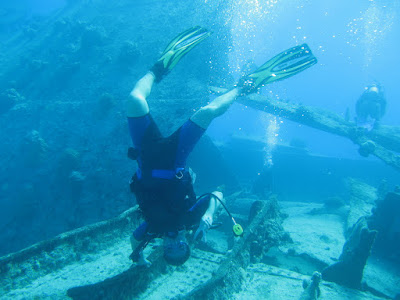
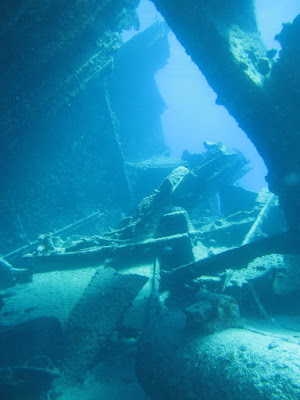
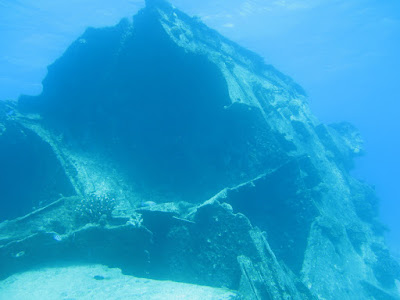


"The Chinsen is a large Japanese freighter that sits at a shallow depth in the lagoon. The ship has been in the water for over 50 years, allowing for some significant coral growth as well as becoming a home to thousands of fish. There are monstrous Red Snappers as well as Big Eye Emperors patrolling the wreck while huge schools of Goat Fish sit on top."


Saturday, November 18, 2006
Wing Beach: An Adopt-a-Spot Success Story
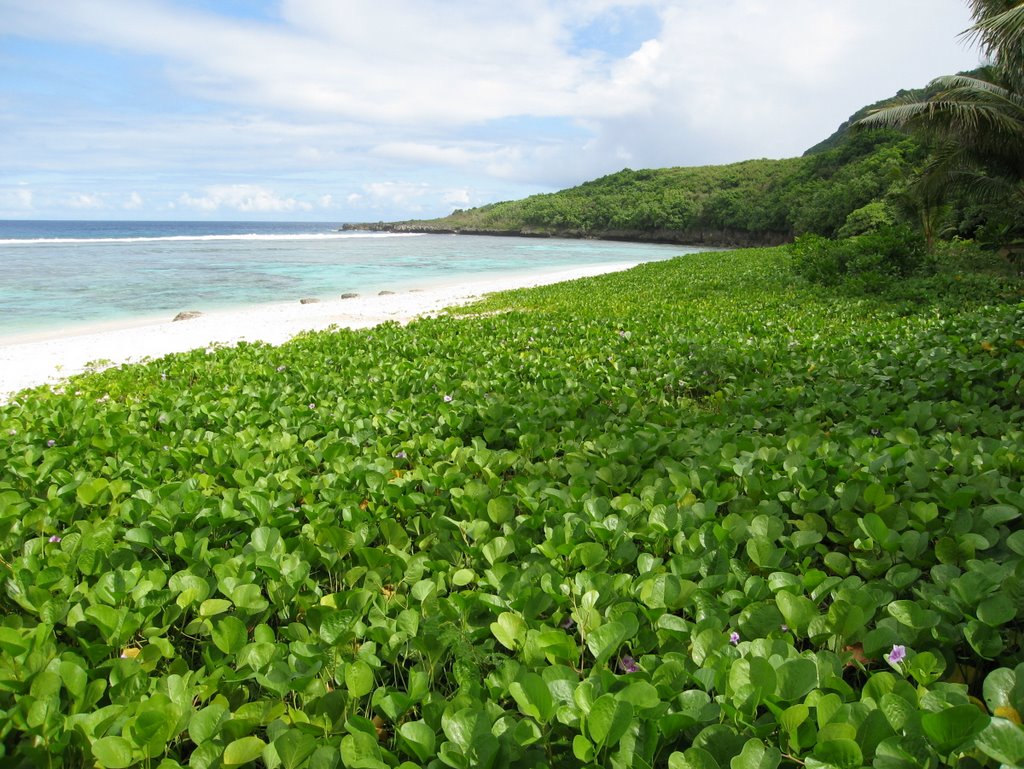 Mariana Islands Nature Alliance (MINA) has adopted Wing Beach as part of Beautify CNMI! and DEQ's Adopt-a-Beach program. They clean up the beach on the third Saturday of every month. November 2006 was the fifth month of consecutive cleanups.
Wing Beach is one of Saipan's hidden jewels. It is on the north end of the island, just past Marianas Resort. Heading north along the road to Marpi, there is a boonie road on the left hand side called Wing Beach Road. Follow it to get to either one of the two Wing Beach entrances.
 The more popular beach entrance is at the end of the road. That is where tourists swim out of a naturally occurring channel to go diving. It is also where a lot of locals bbq on the weekends.
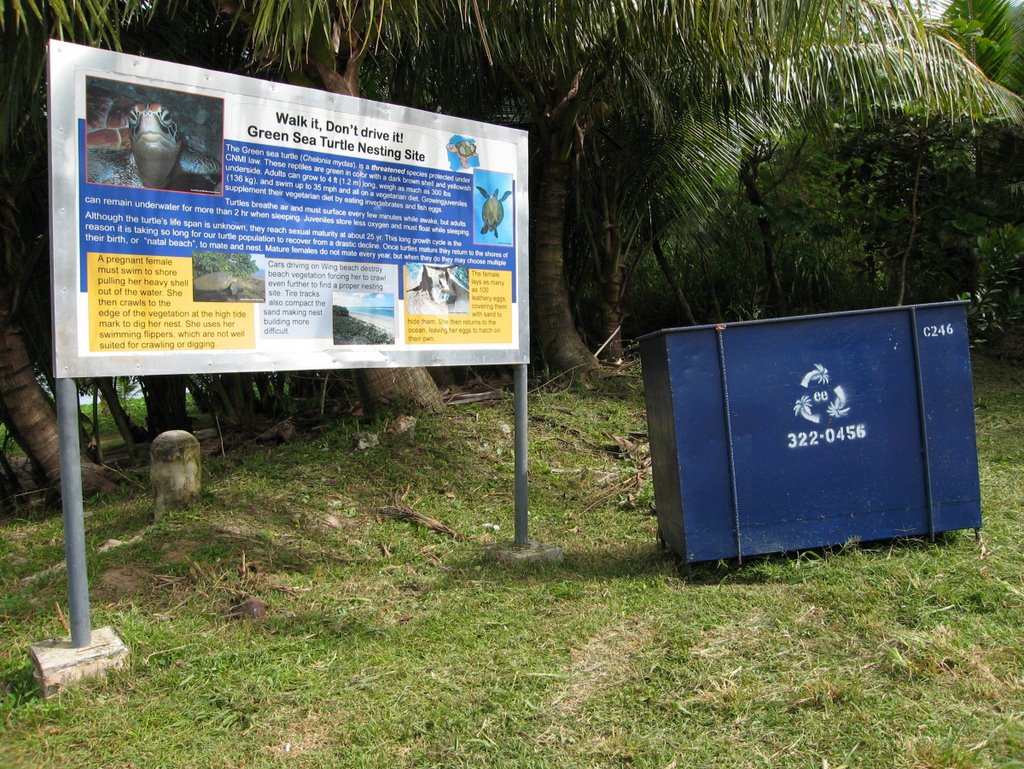 As part of their beach adoption, MINA is paying for weekly trash pickup at Wing Beach. They secured a donation to cover the cost of pickup for one year. The trash container can be found next to the "Walk It, Don't Drive It" sign at the end of the boonie road.
A few years back, Coastal Resource Management Office blocked off vehicular traffic to Wing Beach and put up these educational signs. Driving on the beach drips oil on and impacts the sand, kills vegetation, and increases erosion rates. Vehicles can also crush turtle eggs buried in the sand. Sea turtles are a culturally important species for locals and an economically important species for the local dive industry. Managing this resource by banning vehicular traffic plays an important part in protecting our local heritage and economy.
It took literally three months of cleanups and the institution of regular trash pickups to get the litter problem under control at Wing Beach. In October 2006, the fourth month of MINA's adoption, the amount of litter on the beach was almost zero. This allowed MINA to start cleaning up the road leading into Wing Beach. They cut the overgrown grass and removed litter that had been hidden along the side of the road for years.
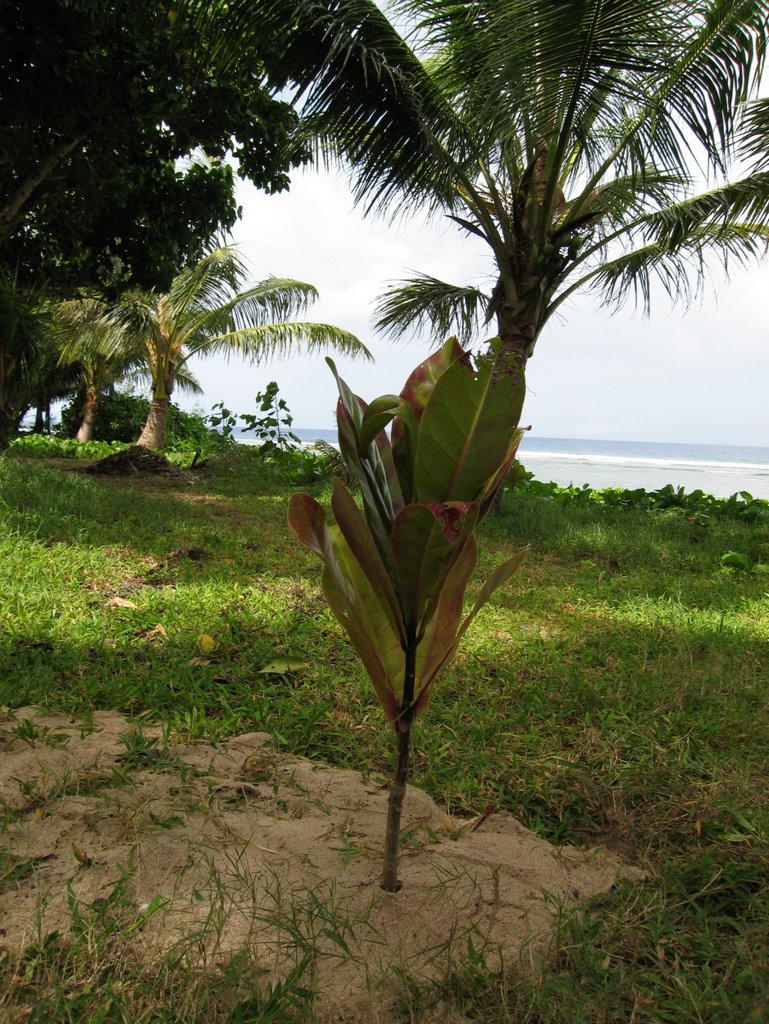 In November 2006, with the litter problem on the beach and along the road under control, MINA, under the supervision of CNMI Forestry, started to remove invasive vine species. They also started planting native forest species along the shoreline to replace the non-native tangan tangan.
Wing Beach is well on its way in becoming one of the nicest beaches in all of Micronesia. Thanks to MINA, it is also definitely now the cleanest.
MINA did not accomplish this alone. Although they were the original adoptees of Wing Beach, they have since been joined by Marianas Resort as co-adoptees. Also, over the course of five months, they have recruited volunteer help from the Marianas Resource Conservation & Development Council, Church of Latter-day Saints, Saipan Grand Hotel, Top Fashion, Saipan Southern High School, Marianas High School, Representative Cinta Kaipat's Office, CNMI Forestry and Marianas Visitors Authority.
It is the hope of Beautify CNMI! that other adopting groups can replicate MINA's success at other locations throughout the CNMI. The most pressing issue at most locations around our islands is the litter problem. As MINA has demonstrated, it can take several months just to get this problem under control. But once the litter problem is under control, that will allow the adopting groups to tackle other problems, like habitat restoration, erosion, and runoff.
Nobody likes picking up other people's trash, but it is the first step in making these islands a better place to live and visit. If you would like more information on Adopt-a-Beach, please contact Reina Camacho at DEQ, 664-8500. If you would like more information on Adopt-a-Road, please contact Frank Tudela at MVA, 664-3200.
MINA has cleaned Wing Beach during the following months:
July 2005
August 2005
September 2005
October 2005
November 2005
Subscribe to:
Posts (Atom)